Microsoft outage live: millions still affected as disruption stretches beyond 18 hours
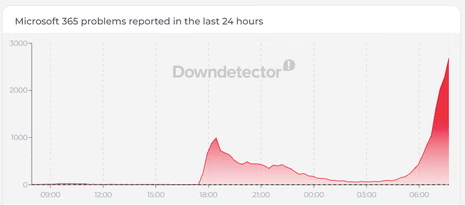
From 5h agoAcross Europe, millions of Microsoft customers will have woken up to the news that the company is strugging to get its services back online.
The disruption, which began around 6pm GMT on Thursday, has disrupted key Microsoft services such as Outlook, Teams and Copilot. Initially mainly affecting US users, it has gone on to cause disruption across the Asia-Pacific region.
Photograph: Downdetector
Microsoft has suggested the outage may have been caused by issues with the settings applied to servers responsible for keeping Microsoft 365 up and running. It says it doesn’t believe it is suffering a cyber attack.
And it became clear that the problem was pretty serious when the company admitted that the fix was “not taking as expected”.
The outage hit government agencies in Australia, Japan and the United States, as well as companies including two massive AI companies – OpenAI and Anthropic.
In Japan, the economy, trade and industry minister said the disruption had had a “major impact,” on the world’s fourth-biggest economy.
Australia’s spy agency and federal police were among the organizations reporting disruption there, with billions of dollars of damage predicted.
The latest word from Microsoft is that it is seeing “positive results for server stability” after applying a software patch.
But despite that, the company still reports “Service degradation on Microsoft 365 (Business or Enterprise) and Microsoft consumer products”.
Key events14m agoYes, US readers, it's still broken
53m agoMicrosoft reports 'encouraging' progress in recovery in Europe
2h agoMicrosoft: We've made more progress
2h agoNHS England: Staff are turning to paper records
2h agoSchools inspector Ofsted, and universities, hit by outage
2h agoRailway passengers may have problems with emailed tickets
2h agoBank of England caught up in Outlook outage
4h agoUK healthcare system seeing 'widespread' and 'serious' disruption
4h agoMicrosoft: We're seeing 'early signs of stabilization'
4h agoTell us: have you been affected by the Microsoft outage?
4h agoNHS organisations reports issues with Outlook and Teams
4h agoUK government putting 'contingency plans' in place
4h agoUK police can't receive crime reports online due to Microsoft problems
5h agoSchools: Phone, don't email!
5h agoUK government engineers 'working with Microsoft' now
5h agoMicrosoft outage: The state of play
5h agoMicrosoft outage has "major impact" in Japan
5h agoMicrosoft: we're seeing positive results for server stability
6h agoMicrosoft: seeing 'marginal success' patching servers
6h agoTech giants and international airlines say they’ve been hit by outage
6h agoMicrosoft’s global outage will cost Australia billions, expert says
10h agoMicrosoft outage may persist as fix is 'not taking as expected'
11h agoVictorian government warns of opportunistic scammers amid outage
12h ago'Looks like we will have to talk to people’: Australians on their email-free day
12h agoWA government: 'Microsoft are prioritising life, safety and Government services'
12h agoWhat we know so far about the global Microsoft outage
13h agoMicrosoft having issues bringing servers back online
13h agoMicrosoft ‘do not believe they are dealing with a cyber event’, Tony Burke says
13h agoSchools, courts and public service staff affected
13h agoThousands of Australians report issues with Microsoft 365
13h agoWelcome
UK house moves are being disrupted by the Microsoft outage, it appears.
David Strank, who runs Kent-based Stranks Removals & Storage, said that the moves of two customers had been disrupted today while the exchange of another client was also delayed. The hold up could derail their planned move date.
“We’ve got two crews that are waiting for keys at the moment,” Strank told the Guardian.
“They are loaded and sitting outside but can’t do anything. We’ve got a move that we’re supposed to start on 23 November and he’s rung to say that they can’t exchange today because they can’t send any emails.”
For consumers, Microsoft says users may be unable to access or perform several actions in Microsoft 365 services.
But, the software firm says its recovery efforts are “progressing” (which seems to be a gentle way of saying the issue isn’t fixed yet!)
This issue affects Outlook.com, OneDrive, OneNote, Microsoft To Do, Teams, and Microsoft 365 for the web.
Readers in the US may be surprised to wake up to the news that Microsoft's outage is not fixed!
While North America was asleep, there has been widepread disruption around the world – from schools, courts and public services in Australia, to companies and government services in Japan, and then schools, the police and the NHS in the UK.
The cause of the mega-outage, which began around 18 hours ago, is still not known.
Microsoft says it has “no evidence of malicious activity associated with this incident” at this time.
Reminder, it reported around 45 minutes ago that the situation was improving in Europe, Japan and North America.
Many Microsoft 365 services are affected, for example:
Problems with Exchange Online mean users may be unable to access their mailbox using Outlook on the web
Microsoft 365 Education features including Assignments, Reading Progress, and Speaker Progress may be impacted.
Microsoft Copilot 365 – users may be unable to load Copilot Chat or receive responses in the web and desktop apps
The Microsoft To Do app may not load, and users may see operation failures.
On Teams, Microsoft says:
Most of the core functionality including joining calls, meetings, group chats, and channel messages are not impacted. Scenarios that depend on Exchange Online, including Calendar related failures with scheduling, invites, viewing, and meeting edits. Creation of Live or Virtual events fail. Failures with Copilot responses for outlook, calendar, or M365 files, read history, or adding to new chats.
Navigating to App chats, adding new contacts or syncing contacts in settings fail. Standard channels are working fine but users may experience the inability to create or delete private or shared channels.
The UK government say it is seeking to establish “the full picture” of Microsoft outages.
The prime minister’s deputy spokeswoman said:
“We’re working with departments and with Microsoft to establish the full picture, and where services are disrupted, departments have contingency arrangements in place.
“You’ll obviously appreciate this is an ongoing situation, but in the meantime, people are encouraged to follow advice on the services they require for alternative ways to get in touch.”
Some UK doctors have been getting in touch, reporting that their emails are now coming back online after being disrupted by the Microsoft technical problems today.
That suggests there’s progress bringing Outlook back online.
Ofqual, the exam regulator for England, is the latest educational institution to be hit by the Microsoft outage. This morning it advised users that its complaints service was not functioning:
“We are currently experiencing issues with this service, related to the global Microsoft outage.
“We are currently unable to receive complaints, whistleblowing and malpractice submissions.”
It said any urgent enquiries should come by telephone.
The continued disruption at Microsoft shows the importance of building some resilience into your IT setup, points out Steven Watt, Professor of Practice in Cybersecurity at the University of St Andrews:
Organisations should be able to answer some basic questions. Which of our critical processes depend on a single supplier? How long could we operate if that supplier were unavailable? What is our fallback for communicating with staff, customers and regulators? Have we tested it, or do we simply assume it exists?
A continuity plan that relies on the same platform that has just failed is not a plan. Remember manual workarounds – these don’t work any more!
Just in: A slightly more encouraging update from Microsoft.
The software firm says it is “seeing encouraging recovery progress in Europe, with service availability and email delivery performance improving across a growing portion of affected Microsoft 365 infrastructure”.
It adds:
Japan remains comparatively more stable, while North America is also improving, however, some users may still experience intermittent issues as recovery actions continue.
This, don’t forget, is around 18 hours after the outage started!
Germany expects an outage affecting Microsoft services to have a significant impact on German businesses, a digital ministry spokesperson said on Friday.
There have been no reports of major outages in Germany’s federal administration, though, the spokesperson added (via Reuters).
People have been getting in touch who’ve been affected by the outage. Rupert, a local government officer from London contacted the Guardian to say that nothing is happening at his council.
“People can’t do anything, it is paralysed,” he says. “Some departments may be able to function and communicate via mobile, but even then they can’t access their documents to do any work.”
He adds that it goes to show how important Microsoft really is. “I’m sure it will get fixed,” he says, but it’s a reminder that Microsoft is “too big to fail and too embedded into society for there to be a repeat of this.”
The NHS has also been deeply affected. In High Wycombe, Eleanor, a staff nurse says there has been “no access to hospital emails for anyone”.
It’s particularly concerning as they can’t send urgent messages about referrals for cancers or for severe diagnoses, she says, adding:
“It’s slowing our service and putting people at risk of falling in between the cracks of services we provide.”
Steale, an administrator in a community NHS service in greater London is also worried about the impact on patients, explaining:
“Our Teams and Outlook are currently down. Our concerns are about patients who would usually contact us by email, some with very urgent needs and requirements.
“We are as best as possible informing them about the outage and to contact us by phone until further notice.”
Reminder, you can tell us how you’re affected here:
Tell us: have you been affected by the Microsoft outage? Read moreNHS Tayside has reported that GP practices are experiencing disruption with email and communication systems.
Posting on Facebook, it says:
Core clinical systems remain available, allowing practices to access patient records, make referrals and order tests. However, some practices are reporting difficulties receiving test results, processing prescription requests and using messaging systems, so not all services are working as normal.
Back in the world of education, University College London, the UK’s largest campus university, said this morning that “teaching is happening as normal” despite university emails and calendars being unavailable because of the outage.
Another update from Microsoft has landed.
The software company says:
We’ve made additional progress toward service recovery, with recovery actions completed across portions of the affected infrastructure in the Asia Pacific region.
Traffic is being gradually restored, and we’re seeing improvements in key customer scenarios, including mailbox access and delayed email processing. However, some users may continue to experience intermittent issues.
Microsoft adds that it is now focusing on “extending these recovery actions across affected infrastructure in other regions”. It is also continuing its stabilization efforts and adding supporting capacity to “improve service consistency”.
NHS England said health staff were resorting to using patients’ paper records or alternative IT systems amid the Microsoft outage.
Patients were urged to attend appointments on Friday unless advised otherwise, and continue to use 999 for emergency situations.
An NHS England spokesperson said:
“With the global Microsoft issue inevitably having a disruptive impact for staff, local NHS services are enacting long-standing measures to manage IT outages and ensure critical services and appointments can continue for patients today – including using other IT systems or paper records where possible.
“Patients should continue to use 999 in an emergency, and otherwise use 111, 111 online, or their local pharmacy, and come forward for appointments unless told otherwise.”
School inspections in England have been disrupted by the Microsoft outage after Ofsted said it was unable to receive emails, as hundreds of schools, colleges and universities across the UK were affected, our education editor Richard Adams reports.
In a message Ofsted said: “Ofsted cannot currently receive emails because of a global Microsoft outage. Please do not send emails to Ofsted at this time,” and advised using online forms or telephone lines for “urgent matters” only.
Schools subscribing to Microsoft services for emails and internal IT have been asking parents to use school apps or phones to report any childrens’ absences (see earlier post) but have otherwise been operating as normal.
Some teachers reported a “refreshing” lack of emails from their school’s management overnight.
The higher education sector is likely to be the hardest hit, with many UK universities relying on Outlook, OneDrive and other Microsoft services for administration and communications, although Teams appears to be functioning for some online meetings.
The University of Manchester, one of the UK’s largest universities, told students and staff to try “alternative methods” of contact and to use telephones for “urgent external communications”.
It also advised:
“If you need to continue working on documents, save them locally to your computer rather than relying on OneDrive or SharePoint.
Avoid repeatedly attempting to sync files while services are disrupted.”
The University of Oxford posted on LinkedIn:
“A global Microsoft outage is affecting some university systems, including Outlook, which is currently unavailable.”
Microsoft’s email outage is also hampering UK railway operators’ ability to process ticket confirmation.
National Rail, which provides information across the network, has warned that people may not be able to access tickets that have been emailed to them, saying:
We’re aware of the ongoing Microsoft global outage, which may be affecting customers’ ability to access their train tickets via their email inbox.
If you’re unable to locate or access your tickets through your email due to this issue, you may still be able to access your tickets by visiting the website or app where you purchased your tickets from and logging into your account.
We recommend doing this before you travel to ensure you have your tickets readily available for your journey. This may not be possible if you checked out as a guest - please contact your ticket retailer directly if you are unable to access your tickets.
If you are still unable to access your ticket, please contact a member of onboard staff or station staff for advice.
Great Western Railway have recommended accessing their tickets through the GWR app or by visiting the My Journeys section on their GWR account.
National Rail also warn that Outlook users who have set up alerts to be received via email may not receive them either.
The UK’s top financial regulators, Bank of England and Financial Conduct Authority, have both been hit by the Outlook outage, my colleague Kalyeena Makortoff.
A Bank of England spokesperson said:
“We are aware of the Microsoft issues affecting their services globally. All critical operations at the Bank are running normally.”
It’s understood that Bank of England staffers are having to divert any email to Teams chats (though of course that doesn’t necessarily help with external communications).
The FCA said they were aware of the global outage and were keeping an eye out how it was affecting City firms more widely, given Microsoft is one of the firms under its supervision (as a provider of critical services to the financial sector).
Both the FCA and Bank of England were handed powers in July to start directly overseeing the local arms of Google Cloud and three other Silicon Valley rivals - Amazon Web Services, Oracle and Microsoft – after being designated as critical third parties by the UK government, as their services become a crucial part of increasingly digital banking services.
Explore more on these topicsMicrosoft
Computing
ShareReuse this content